
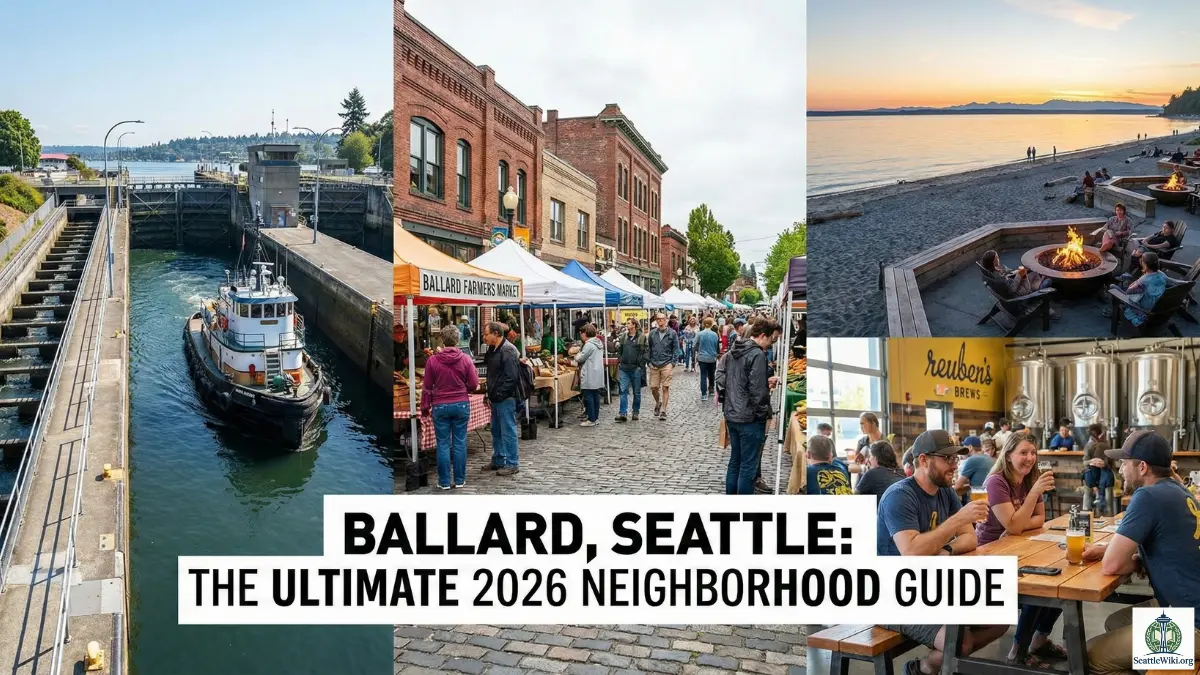
Everything You Need to Know About Seattle’s Historic Maritime Enclave
If there is one neighborhood that perfectly encapsulates the “Old vs. New” spirit of Seattle in 2026, it is Ballard.
Once a sleepy Scandinavian fishing village independent of Seattle (until it was annexed in 1907), Ballard has transformed into one of the most vibrant, self-sufficient, and desirable districts in the Pacific Northwest. Walk down Ballard Avenue today, and you will see a gritty commercial trawler passing through the locks on one side, and a line of tech workers waiting for saffron-infused cocktails on the other.
For newcomers and long-time residents alike, Ballard offers a unique “city within a city” vibe. It has its own downtown, its own beach, its own industrial district, and arguably the best beer scene on the West Coast.
Table of Contents
This comprehensive wiki guide covers everything from the Ballard Locks and the Brewery District to the 2026 real estate outlook and the famous Sunday Farmers Market.
The Vibe: Where Maritime Meets Modern
Ballard is located in Northwest Seattle, bordered by the Puget Sound to the west and the Lake Washington Ship Canal to the south. This geography defines its character.
The “Snoose Junction” Heritage Historically, this was the home of Scandinavian immigrants who worked in the fishing and shingle industries. You still see this influence everywhere, from the National Nordic Museum on Market Street to the flags flying during the Syttende Mai (17th of May) parade.
The 2026 Reality Today, Ballard is a bustling urban village. The single-story fishermen’s cottages are now mixed with modern six-story apartment complexes. It is walkable, bike-friendly, and packed with amenities. It is popular with young families, Amazon/Google employees (who commute via the connector shuttles), and artists holding onto the neighborhood’s funky roots.
Top Things to Do in Ballard (The Big Three)
If you are visiting for a day, there are three non-negotiable landmarks you must see. These are the anchors of the neighborhood.
1. The Hiram M. Chittenden Locks (Ballard Locks)
No trip to Ballard is complete without visiting the Locks. Built in 1917, this engineering marvel lowers boats from the freshwater of Lake Union to the saltwater of Puget Sound.
- What to do: Watch yachts, tugboats, and massive barges navigate the narrow chambers.
- The Fish Ladder: In late summer and early fall, head to the viewing windows to watch Salmon fight their way upstream to spawn.
- Carl S. English Jr. Botanical Garden: Located right on the grounds, this is one of the most peaceful picnic spots in the city.
2. Golden Gardens Park
Located at the northern tip of the neighborhood, Golden Gardens is arguably Seattle’s best beach.
- The Vibe: Sandy beaches (rare in Washington), restored wetlands, and panoramic views of the Olympic Mountains.
- The Fire Pits: This is one of the few places in Seattle where beach bonfires are legal. In 2026, the city still uses a strict “first-come, first-served” policy for the fire rings, so arrive by 4:00 PM if you want a spot on a sunny Friday.
3. The National Nordic Museum
Recently moved to a stunning modern facility on Market Street, this museum connects the neighborhood’s past to the broader Nordic experience. It’s not just about Vikings; it covers immigration, design, and environmental sustainability.
The Ballard Brewery District: “Beer Lover’s Paradise”
Ballard has the highest density of breweries of any neighborhood in the Pacific Northwest. The area roughly between 14th Ave NW and 8th Ave NW is known as the “Brewery District.”
You can easily spend an entire Saturday walking from taproom to taproom.
Must-Visit Spots:
- Reuben’s Brews: The heavyweight champion of the neighborhood. Known for their diverse tap list and massive outdoor patio.
- Stoup Brewing: Famous for their IPAs and science-driven brewing approach.
- Obec Brewing: A hidden gem for those who prefer Czech-style lagers over hoppy IPAs.
- Great Notion: If you like sour beers that taste like blueberry pancakes or hazy IPAs, this is your spot.
Pro Tip: Most breweries here are dog-friendly and kid-friendly (until 7 PM), making it a community gathering space rather than just a bar scene.
Shopping & Culture: The Market Street Corridor
The heart of Ballard’s retail scene runs along NW Market Street and the historic cobblestone stretch of Ballard Avenue NW.
The Ballard Farmers Market Held every Sunday from 10:00 AM to 3:00 PM on Ballard Avenue, this is widely considered the best farmers market in Seattle.
- Why it’s special: It is a year-round, rain-or-shine market. The street is closed to cars, and vendors sell everything from local honey and organic kale to fresh oysters and handmade jewelry.
- 2026 Status: The market remains a “locals-first” event, though it draws heavy tourist crowds in the summer.
Independent Boutiques Unlike downtown Seattle, Ballard has resisted big-box retail. You will find curated bookshops like Secret Garden Books, outdoor gear shops, and vintage clothing stores.
Dining & Nightlife
The culinary scene in Ballard rivals Capitol Hill. The focus here is on “casual excellence”—amazing food served in a relaxed atmosphere.
- The Walrus and the Carpenter: An iconic oyster bar tucked away in the back of a building. It’s expensive, but the experience is quintessential Seattle.
- San Fermo: A cozy Italian spot housed in one of the oldest pioneer houses in the neighborhood.
- Bitterroot BBQ: The place to go for Pacific Northwest-style bourbon and BBQ.
- Nightlife: Ballard isn’t a “club” neighborhood. It’s a “dive bar and live music” neighborhood. Venues like The Tractor Tavern and Sunset Tavern host indie folk, rock, and alt-country bands almost every night.
Living in Ballard: 2026 Real Estate & Transit Update
For those considering moving here, the landscape has changed significantly over the last five years.
Housing Market 2026 Ballard is a “supply-constrained” market.
- Condos & Apartments: A massive new project, the Ballard Blossom development (1740 NW Market St), is breaking ground in March 2026. This will add hundreds of units, but rent remains high due to demand.
- Single Family Homes: The side streets are lined with Craftsman-style homes that sell for a premium. Bidding wars are common for homes within walking distance of Market Street.
The Transit Reality (The Light Rail Wait) If you move to Ballard in 2026, you need to know about the transit gap.
- Light Rail: The Ballard Link Extension (which will eventually connect Ballard to Downtown via a new tunnel) is currently in the “Draft EIS” phase. Construction hasn’t started, and the opening date is scheduled for 2039.
- RapidRide D Line: This bus is the main artery. It connects Ballard to Downtown Seattle. It is frequent (every 10 minutes) but can get overcrowded during rush hour.
- Bike Commuting: The Burke-Gilman Trail ends in Ballard (at Golden Gardens). This is a “bicycle highway” that allows you to ride all the way to the University of Washington or Fremont without fighting car traffic.
Ballard vs. Fremont: Which is Better?
A common question for visitors is whether to spend their day in Ballard or its neighbor, Fremont.
- Choose Ballard if: You want ocean views (Golden Gardens), a massive selection of breweries, and a more “lived-in” neighborhood feel. It feels like a complete town.
- Choose Fremont if: You want quirky art (The Troll), proximity to Lake Union, and a slightly younger, tech-heavy crowd.
The Verdict: Ballard is generally considered the “grown-up” version of Fremont. It is where people move when they want to settle down but still want cool bars and walkability.
Seasonal Events
Ballard residents take their local pride seriously, and nothing shows this more than their festivals.
- Syttende Mai (May 17th): The Norwegian Constitution Day parade. It is the largest celebration of its kind outside of Norway.
- Ballard SeafoodFest (July): A massive street fair featuring a salmon BBQ, beer gardens, and live music stages.
- Ballard ArtWalk: Held the second Saturday of every month. In 2026, the ArtWalk has expanded to include live glass-blowing demos and street performers.
Hidden Gems (Local Secrets)
- Sunset Hill Park: A tiny pocket park high on a bluff overlooking the water. It offers the same view as Golden Gardens but without the crowds.
- Top Pot Doughnuts: The “downtown” Ballard location is housed in a unique, oval-shaped mid-century building (formerly a library).
- BOP (Ballard on the Park): The rooftop deck here (if you know a resident) has one of the best 360-degree views in the city.
Conclusion
In 2026, Ballard remains the crown jewel of Seattle’s neighborhoods. It has managed to absorb thousands of new residents and modern apartment blocks without losing its gritty, maritime soul.
Whether you are watching the salmon ladder at the Locks, sipping a hazy IPA at Stoup, or hunting for antiques on Ballard Avenue, this neighborhood demands your attention. It is a place where history is honored, but progress is welcomed—usually with a craft beer in hand.
Frequently Asked Questions (FAQ)
Q: Is Ballard Seattle safe?
A: Yes, Ballard is generally considered safe, especially the residential streets north of Market Street and Sunset Hill. Like any urban hub, vehicle prowls (car break-ins) can occur, so do not leave valuables in your car.
Q: How far is Ballard from downtown Seattle?
A: Ballard is about 5-6 miles north of downtown. It typically takes 20-30 minutes by car or 35-45 minutes via the RapidRide D Line bus.
Q: Does the Light Rail go to Ballard yet?
A: No. As of 2026, the Light Rail extension to Ballard is still in the planning phase and is not expected to open until 2039.
Q: What is the best day to visit Ballard?
A: Sunday is the best day because the Ballard Farmers Market is in full swing, creating a lively pedestrian-friendly atmosphere on Ballard Avenue.
Q: Can you swim at Golden Gardens?
A: Yes, but be warned: the water in Puget Sound is very cold (around 50-55°F) year-round. Most locals sunbathe or paddleboard rather than swim.
Q: What is the “Ballard Driving Academy” joke?
A: It is a local meme about how elderly Scandinavian drivers in Ballard used to drive very slowly. With the influx of young tech workers, this stereotype is largely a thing of the past!