
If you only look at the shiny glass towers of South Lake Union, you might think Seattle has lost its soul to corporate tech behemoths. You might think the city that birthed Jimi Hendrix, Nirvana, and the grunge movement has been sanitized into a giant, expensive office park.
You would be wrong.
The soul of Seattle hasn’t disappeared; it just moved. It thrives in specific pockets of the city—neighborhoods that resisted the bland uniformity of modern development and doubled down on their unique, weird, and vibrant identities. We call these “Vibe Zones.”
These are the places where you don’t just live; you exist. They are where the best murals are painted, where the music is loudest, where the food is most inventive, and where you can still find the gritty, authentic energy that put Seattle on the cultural map.
As we head into 2026, these are the four essential neighborhoods holding down the culture of the Emerald City.
1. Capitol Hill: The Neon Heartbeat
If Seattle had a Brooklyn, this would be it. Capitol Hill is the undisputed epicenter of nightlife, LGBTQ+ culture, and counter-culture energy. It is dense, loud, and unapologetically intense.
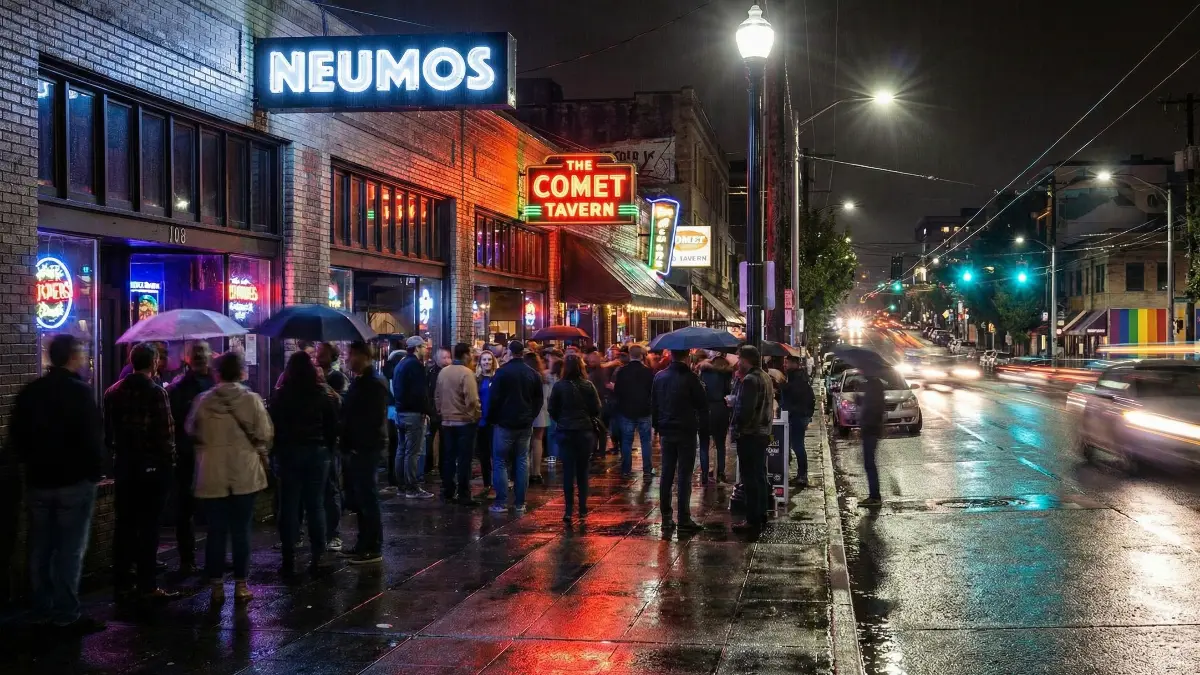
The Vibe: Walking down the Pike/Pine corridor on a Friday night feels like walking through a live-action music video. The air smells like street tacos and expensive cannabis. The sidewalks are overflowing with people hopping between bars, underground clubs, and late-night pizza joints. It is the most diverse and expressive neighborhood in the city, marked by the iconic rainbow crosswalks that act as its spiritual center.
Key Spots & Experiences:
- The Pike/Pine Corridor: The main drag. It’s home to legendary music venues like Neumos, where you can see the next big indie band before they blow up. Across the street is The Comet Tavern, a former dive bar that—despite being cleaned up a bit—still holds onto its rock-and-roll roots.
- Cal Anderson Park: This isn’t just a patch of grass; it’s the neighborhood’s living room. On a sunny day, it’s packed with people playing dodgeball, picnicking, and protesting. It’s the beating heart of the community’s civic life.
- Elliott Bay Book Company: An enormous, independent bookstore with creaky wooden floors and a fantastic cafe inside (Little Oddfellows). It’s a quiet sanctuary in the middle of the chaos and hosts readings from major authors almost daily.
Living Here: Living on “The Hill” means you never need a car (the Light Rail station is right in the center) and you are never bored. The trade-off is noise. If your apartment faces Pike Street, buy industrial-grade earplugs. You will hear drunken karaoke renditions of “Bohemian Rhapsody” at 2 AM every weekend.
2. Ballard: The Scandi-Cool Brewery Capital
Once a sleepy Scandinavian fishing village, Ballard has transformed into one of the trendiest spots in the Pacific Northwest without losing its maritime grit.
The Vibe: Ballard feels like a separate town that just happens to be attached to Seattle. The vibe is mature hipster meets salty sea captain. It’s famous for having the highest concentration of breweries per square mile nearly anywhere on Earth. The aesthetic is brick buildings, industrial warehouses converted into taprooms, and a working waterfront where fishing boats still dock.
Key Spots & Experiences:
- The Brewery District: You could spend a month here and not hit every brewery. Start at Reuben’s Brews (for award-winning IPAs) and waddle your way to Stoup Brewing or Urban Family. Most are family and dog-friendly, with food trucks parked outside.
- Ballard Avenue NW: This tree-lined street is one of the most beautiful in the city. It’s packed with incredible restaurants like The Walrus and the Carpenter (famous oysters) and boutique shops selling everything from vintage denim to high-end kitchenware.
- The Ballard Locks: A feat of engineering where you can watch massive boats being raised and lowered between the Puget Sound and the freshwater lakes. In the summer, you can watch salmon fighting their way up the fish ladder.
- The Sunday Farmers Market: This is not just a market; it’s a weekly ritual. The entire neighborhood shuts down Ballard Ave to buy local produce, flowers, and artisanal bread. It is arguably the best farmers market in the entire state.
Living Here: Ballard boasts an incredibly strong sense of community. People settle down here. The massive downside is the commute. There is no Light Rail, and getting downtown during rush hour can take 45 minutes by bus. You live in Ballard because you plan to spend your weekends in Ballard.
3. Fremont: The Self-Proclaimed “Center of the Universe”
Fremont’s motto is “De Libertas Quirkas”—Freedom to be Peculiar. It wears its weirdness as a badge of honor.
The Vibe: Located just east of Ballard along the ship canal, Fremont is artsy, whimsical, and proudly eccentric. While it now hosts major tech offices for Google and Adobe, it fights hard to keep its funky soul. It’s the kind of place where public art isn’t just decoration; it’s a statement.
Key Spots & Experiences:
- The Fremont Troll: You cannot visit Seattle without paying tribute to the Troll. This massive mixed-media sculpture crushes an actual Volkswagen Beetle under a bridge. It’s the ultimate photo op.
- The Lenin Statue: Yes, there is a giant bronze statue of Vladimir Lenin standing on a street corner. It was rescued from pop art obscurity in Slovakia and brought here. It’s controversial, bizarre, and very Fremont.
- The Fremont Solstice Parade: Held every June, this parade is famous for its hundreds of naked bicyclists painted head-to-toe in elaborate artistic designs right before the main floats start. It is a joyful, chaotic celebration of summer.
- The Sunday Market: A quirky flea market that feels more like a bazaar. You can find vintage clothes, strange antiques, and global street food.
Living Here: Fremont offers a perfect balance. It is incredibly walkable, located right on the Burke-Gilman bike trail, and has a fun nightlife scene that is less intense than Capitol Hill. It’s popular with young tech workers who want a short commute to the Google campus but still want to live somewhere with character.
4. Georgetown: The Gritty Industrial Arts District
If the other neighborhoods on this list are too polished or gentrified for you, head south to Georgetown.
The Vibe: This is Seattle’s oldest neighborhood and its last true bastion of industrial grit. Surrounded by Boeing fields, train tracks, and highways, Georgetown is raw, dusty, and incredibly cool. It’s a haven for artists, punks, mechanics, and anyone who prefers a dive bar over a mixology lounge. It feels authentically blue-collar and creative.
Key Spots & Experiences:
- The Trailer Park Mall: A collection of vintage Airstream trailers converted into tiny boutique shops selling handmade jewelry, vintage records, and oddities. It’s only open on weekends and is pure Americana kitsch.
- Fantagraphics Bookstore & Gallery: The headquarters of one of the world’s most important publisher of alternative comics and graphic novels. A must-visit for art lovers.
- Georgetown Art Attack: On the second Saturday of every month, the neighborhood’s galleries and studios open their doors for a massive, free art walk that feels like a block party.
- Jules Maes Saloon: One of the oldest bars in Seattle. It’s a classic, no-frills spot for a cheap beer and a game of pool.
Living Here: Georgetown is cheaper than most “cool” neighborhoods, but it comes with environmental noise. You will hear airplanes from the nearby King County International Airport and heavy freight trains rumbling through at all hours. It is not for light sleepers, but for those who love it, the authenticity is worth the noise.
Final Verdict: Finding Your Frequency
Seattle isn’t a monolith. It’s a collection of villages, each with its own frequency.
- If you want loud music, inclusivity, and 2 AM pizza, head to Capitol Hill.
- If you want craft beer, oysters, and a maritime feel, go to Ballard.
- If you want whimsical art and naked bike rides, choose Fremont.
- If you want gritty authenticity and underground art, seek out Georgetown.
The best way to experience them is to pick one, go there around 6 PM on a Friday, put your phone away, and just follow the noise.