
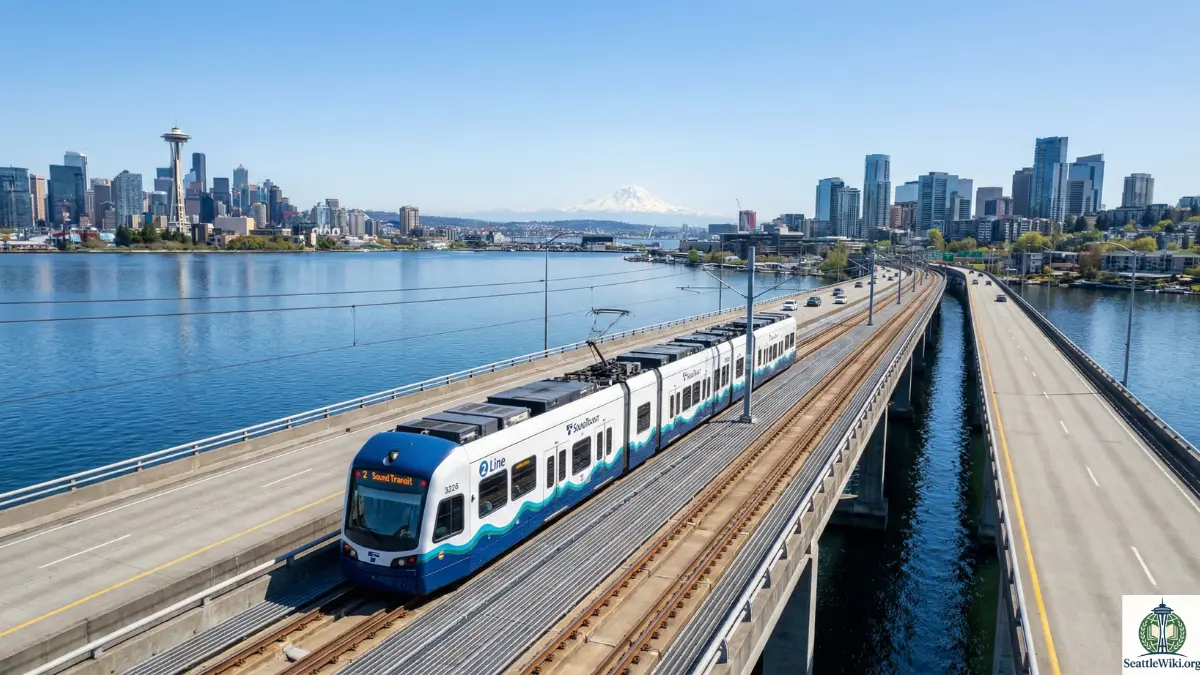
Introduction: The End of the “Ghost Train” Era
If you live in Seattle and commute to the Eastside (or vice versa), you know the specific kind of torture that is the I-90 floating bridge at 5:00 PM. You are sitting there, brake lights glowing red as far as the eye can see, rain streaking your windshield, inching toward the Mount Baker Tunnel.
And for the last two years, you’ve looked to your left (or right) and seen something frustrating: pristine, empty train tracks.
Table of Contents
Since 2024, the “2 Line” has been a tease. It has been running in isolation on the Eastside—shuttling tech workers from South Bellevue to Redmond—but the vital artery, the connection across Lake Washington, has been silent. We’ve watched the test trains glide back and forth, empty and mocking us, while we sit in gridlock.
But as we wake up in January 2026, the narrative is finally changing. The concrete plinths are fixed, the safety testing is wrapping up, and Sound Transit has a target that feels real. The “Ghost Train” is about to become your daily ride.
Here is everything you need to know about the Sound Transit 2 Line opening date, the neighborhood impacts, and how your life is about to change this Spring.
The Big Question: Sound Transit 2 Line Opening Date Confirmed?
Let’s cut through the rumors and the Reddit threads. After years of “quality control issues” and the infamous concrete plinth reconstruction that pushed this project back, we finally have a solid target.
The full Sound Transit 2 Line opening date is projected for April 2026.
While Sound Transit officials are always cautious with their wording (using phrases like “Spring 2026 Service Launch”), sources and construction milestones point to an April kickoff. This isn’t just a ribbon-cutting ceremony; this is the moment the “Blue Line” (as locals call it) becomes a true regional connector rather than just a Bellevue circulator.
Why April?
April isn’t arbitrary. Sound Transit typically schedules major service changes (known as “service shakes”) in March or September to align with King County Metro bus restructuring. An April launch allows them to finalize the winter testing—ensuring the trains can handle the unique engineering challenge of the floating bridge during high winds and waves—before the spring commuter rush begins.
So, if you are planning your lease renewal or a job change, circle April 2026 on your calendar. That is when the barriers come down.
Navigating the Seattle Light Rail Map 2026
For the past two years, looking at a Seattle light rail map 2026 has been a bit confusing. You had the “1 Line” (Green) running from Lynnwood to Angle Lake, and the “2 Line” (Blue) stranded on the Eastside like an island.
In Spring 2026, those two lines finally kiss.
The Full Route: A 14-Mile Game Changer
The “East Link” adds 10 new stations connecting Seattle’s International District to Redmond Technology Station. But the magic happens at International District/Chinatown Station. This will become the system’s massive transfer hub.
Here is what the new continuous ride looks like:
- Lynnwood to Seattle: The existing 1 Line brings commuters down from the north.
- The Transfer (ID/Chinatown): Riders can switch platforms to head East.
- The Cross-Lake Journey: The train dives onto the I-90 floating bridge.
- The Eastside Arrival: It hits Mercer Island, South Bellevue, and continues up to Microsoft’s doorstep in Redmond.
Who Does This Help? (The Commuter Personas)
This update isn’t just for tech workers. It radically shifts the geometry of the city.
- The “Capitol Hill to Expedia/T-Mobile” Commuter:
- Old Reality: Driving down Broadway, fighting I-5 or I-90 traffic, parking in Factoria.
- New Reality: Hop on at Capitol Hill Station, transfer at ID/Chinatown, and be in Bellevue Downtown in roughly 25 minutes. No parking fees, no road rage.
- The “Bellevue to ballgames” Fan:
- Old Reality: An expensive Uber to T-Mobile Park or Lumen Field.
- New Reality: A one-seat ride from Wilburton or Spring District straight to the stadium district.
Crossing the Gap: The Bellevue to Seattle Train Connection
To understand why this is such a big deal, we have to look at “The Gap.”
For the last 24 months, the train has been operating in what transit nerds call a “stub service.” You could take the train from South Bellevue to Redmond Technology Center. It was great if you lived in Factoria and worked at Microsoft, but useless if you needed to cross the lake.
The Bellevue to Seattle train connection is an engineering marvel that caused all the delays.
The Floating Bridge Challenge
The I-90 bridge is a floating pontoon bridge. It moves. It rises and falls with the lake levels, and it sways left and right with the wind. Train tracks, generally, hate moving. They like to be rigid.
Sound Transit had to invent a world-first technology: a “track bridge” that allows the steel rails to flex and bend safely as the bridge moves beneath them, without derailing a train moving at 55 mph. The “Gap” we have been waiting for wasn’t just laying track; it was perfecting this safety mechanism and fixing the concrete supports (plinths) that held it all together.
That work is done. The “Gap” is closed. When you ride this in April, take a moment to look out the window as you cross Lake Washington. You are riding on the only light rail system in the world that floats on water.
The “Judkins Park Effect”: Real Estate & Rent Spikes
Real estate agents have been whispering about this for five years, but now that the opening is weeks away, the market is reacting.
The biggest winner—and perhaps the most vulnerable neighborhood for rent hikes—is Judkins Park.
Why Judkins Park?
Judkins Park Station is the first stop on the Seattle side of the bridge. It is nestled in the Central District, right near Rainier Avenue.
- The Commute Hack: From Judkins Park, you are roughly 8 minutes from Downtown Bellevue and 5 minutes from Downtown Seattle. It is geographically the most central point for a dual-income couple where one works at Amazon (SLU) and the other works at Microsoft (Redmond).
- The “Goldilocks” Zone: It has historically been cheaper than Capitol Hill or Downtown Bellevue. That is changing fast.
The Prediction: Spring 2026
As we approach the April opening, expect to see:
- Rent Spikes: Older apartment buildings along Rainier Ave and 23rd Ave will likely see rent increases of 10-15% as landlords market “Direct Light Rail Access.”
- New Inventory: The massive developments that have been under construction near the I-90 lid are timing their pre-leasing for February/March 2026.
- Parking Wars: Since Judkins Park Station does not have a massive Park & Ride garage (unlike South Bellevue), street parking in the surrounding neighborhood will become a battleground. If you live within a 10-minute walk of the station, getting a Zone Parking Permit is now mandatory for survival.
Insider Tip: If you are looking to move, look at the “North Beacon Hill” area just above the station. You get the access to the train without the noise of Rainier Avenue, and it’s still somewhat undervalued compared to the Central District core.
The Eastside “Starter Line” vs. The Real Deal
It is important to acknowledge that for many Eastsiders, the train is “old news.” The 2 Line has been running since 2024. But let’s be honest: ridership has been low.
Why? Because a train that doesn’t go to Seattle is a train that ignores 60% of the region’s travel needs.
The Psychology of the “Full Line”
When the connection opens in April, the “Starter Line” stations are going to transform.
- South Bellevue Station: This massive parking garage has been sitting half-empty. Come April, if you aren’t parked there by 7:30 AM, you won’t get a spot. It will become the primary “intercept” point for commuters coming from Issaquah and Sammamish who want to avoid the I-90 bridge toll and traffic.
- Mercer Island Station: This station has been a ghost town because the train only went East. Now, it becomes the most exclusive commute in Washington. Mercer Island residents will have a 7-minute ride to downtown Seattle.
The “Starter Line” was a dress rehearsal. April 2026 is Opening Night.
Commuter Survival Guide: What Changes in Spring 2026?
Okay, so the train is coming. What does that mean for your daily grind? If you are a creature of habit, prepare for a shock.
1. The “Bus Spill”
When Light Rail opens, King County Metro and Sound Transit delete bus routes. They do not run parallel service.
- The 550 Express: The legendary bus route from Bellevue to Seattle? It will likely be retired or severely reduced.
- The 554: This route (from Issaquah) will likely change to terminate at a light rail station (like Mercer Island or South Bellevue) rather than driving all the way into downtown Seattle.
- The Takeaway: You will likely lose your “one-seat bus ride.” You will have to transfer. However, your trip will be consistent. No more getting stuck in traffic because of a fender bender on the bridge.
2. The ORCA Card Factor
If you haven’t used public transit in a while, ensure your employer has updated your ORCA benefits. The “taping on/tapping off” culture is strict on Light Rail. Fare enforcement officers have been more active in 2025/2026 than in previous years.
3. The Crowds
The first month (April) will be chaotic. Tourists, train enthusiasts, and confused commuters will pack the cars.
- Pro Tip: If you are commuting from Seattle to Bellevue in the morning, sit in the front car. It usually has slightly more room.
- Bike Commuters: Be careful. The bike hooks on the new Siemens trains are great, but during rush hour, bringing a bike on board the “Bridge Run” might be impossible due to crowding. Use the secure bike lockers at the stations instead.
Beyond 2026: The Next Frontier
While we are celebrating the Sound Transit 2 Line opening date, it’s worth zooming out on the Seattle light rail map 2026 to see what’s next.
April 2026 completes the “Spine” of the Eastside. But the work isn’t done.
- Downtown Redmond Extension: Two more stations extend the line into Marymoor Park and Downtown Redmond. That is the next domino to fall (likely late 2026 or 2027).
- West Seattle & Ballard: Those projects are still years away (into the 2030s), but the completion of the 2 Line proves that Sound Transit can eventually conquer the difficult water crossings.
Conclusion: A City Connected
For decades, Seattle and the Eastside have felt like two different cities separated by a moat. You were either a “Seattle person” or an “Eastside person,” and crossing the bridge was a chore reserved for special occasions or mandatory commutes.
In April 2026, that psychological barrier dissolves.
When you step onto the train at Pioneer Square and step off in the Spring District 20 minutes later to grab a coffee, the region will feel smaller, tighter, and more accessible. The Bellevue to Seattle train isn’t just transit; it’s a unification of the Puget Sound.
So, get your ORCA card ready. The bridge is open.
FAQ: Seattle Light Rail 2026
Q: Will the 2 Line run 24 hours a day?
A: No. Like the 1 Line, the 2 Line will shut down roughly between 1:00 AM and 5:00 AM for maintenance.
Q: How much will a ticket cost from Seattle to Bellevue?
A: Fares are distance-based. Expect a one-way trip to cost roughly $3.25 to $3.50 (rates subject to Sound Transit 2026 adjustments).
Q: Is there parking at every station?
A: No. South Bellevue has a massive garage (1,500 stalls). Bellevue Downtown and Judkins Park have no dedicated park-and-ride garages. You must walk, bus, or drop-off.
Q: Can I take the train to the airport from Bellevue?
A: Yes! You will take the 2 Line to International District/Chinatown, get off, walk across the platform, and board the 1 Line (Southbound) to SeaTac. The total trip should take about 60-70 minutes.