If you try to drive in downtown Seattle at 5:00 PM, you will regret it.
Between the rain, the one-way streets, and the infamous “Mercer Mess,” driving in the Emerald City is a test of patience. Fortunately, Seattle has one of the best public transit systems in the US, and it is getting a massive upgrade in 2026.
Whether you are a new tech worker commuting to South Lake Union or a tourist trying to get from SeaTac Airport to Pike Place Market, this guide is your survival manual.
We will cover everything from the Orca Card hacks to the unwritten rules of riding the Link Light Rail.
💳 The Golden Ticket: The ORCA Card
The One Regional Card for All (ORCA) is the only card you need. It works on the Light Rail, Metro Buses, Streetcars, Water Taxis, and even the Washington State Ferries.
Do Not Pay Cash
While you can pay cash on buses, it is a bad idea for three reasons:
- No Change: If the fare is $3.00 and you have a $5 bill, the driver cannot give you change. You just tipped the city $2.
- No Transfers: Cash users do not get a “transfer slip.” If you take a bus and then switch to the train, you have to pay full price twice. ORCA card users get a 2-hour free transfer window.
- It’s Slow: Fumbling for quarters annoys everyone behind you.
How to Get an ORCA Card in 2026
- The Physical Card ($3 fee): You can buy one at the vending machines at any Link Light Rail station (including the Airport).
- The App (myORCA): Download the myORCA app immediately. You can instantly load money onto your card using Apple Pay or a credit card.
- Warning: The physical card readers on buses sometimes take 24 hours to recognize money loaded via the website, but the app is usually instant.
- Employer Passport: If you work for Amazon, Microsoft, Google, or the University of Washington, your badge likely doubles as an unlimited ORCA card. Check with HR before you buy one.
🚆 The Backbone: Link Light Rail
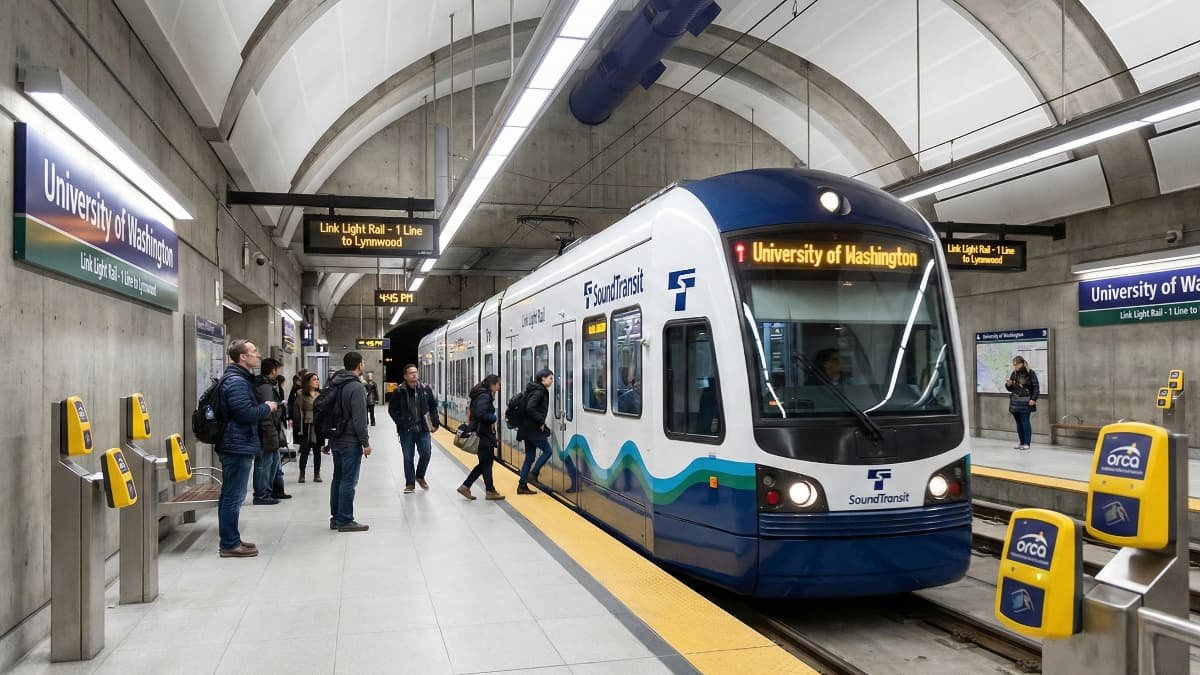
The Link is the spine of Seattle transit. It is clean, fast, and immune to traffic jams. In 2026, the system is expanding significantly.
1 Line (The Green Line)
This is the main line running North-South.
- Route: Connects Lynnwood (North) $rightarrow$ Northgate $rightarrow$ University of Washington $rightarrow$ Capitol Hill $rightarrow$ Downtown $rightarrow$ SeaTac Airport $rightarrow$ Angle Lake (South).
- Frequency: Trains come every 8–10 minutes during the day.
- Cost: Flat fare of $3.00 per trip (Adults). Youth (under 18) ride FREE.
2 Line (The Eastside Line)
This is the new game-changer for 2026.
- The “Crosslake” Connection: As of early 2026, the bridge connection across Lake Washington is finally opening. You can now ride the train from Bellevue or Redmond (Microsoft) directly into Downtown Seattle without transferring to a bus.
- Route: Redmond Tech $\rightarrow$ Bellevue Downtown $\rightarrow$ Mercer Island $\rightarrow$ International District.
🚨 Crucial Light Rail Etiquette
- Tap On, Tap Off: You must tap your ORCA card on the yellow readers on the platform before you board and after you exit.
- Why? Fare enforcement officers patrol random trains. The fine for not tapping is $124.
- The “Seattle Shuffle”: When the train arrives, let people exit before you try to enter. Stand to the side of the doors, not directly in front of them.
✈️ SeaTac Airport Transfer: Link vs. Uber
This is the most common question we get: “Should I Uber or take the train from the airport?”
Here is the math for a trip to Downtown Seattle:
| Feature | Link Light Rail | Uber / Lyft |
| Cost | $3.00 | $55 – $80 |
| Time | 38 Minutes (Reliable) | 35-60 Minutes (Traffic dependent) |
| Convenience | Moderate (5 min walk to garage) | High (Curbside pickup) |
| Luggage | Easy (Level boarding) | Easy (Trunk space) |
The Verdict: Unless you have 4+ suitcases or are arriving at 2 AM, take the Light Rail. It is significantly cheaper and often faster during rush hour.
- How to find it: Follow the signs in the terminal for “Link Light Rail.” You will walk through the parking garage to the station.
🚌 The Bus System: King County Metro
When the train doesn’t go where you need, the bus does. Seattle has two types of buses:
1. RapidRide (The Red Buses)
These are the “Subway on wheels.” They have specific letter names (e.g., E Line, C Line).
- Features: They come every 10–15 minutes, have Wi-Fi, and use all-door boarding.
- How to Board: You can tap your card at the station reader on the sidewalk before the bus arrives, then enter through the back doors.
2. Local Buses (Green/Blue/Teal)
These serve specific neighborhoods.
- How to Board: You must enter through the front door and tap your card next to the driver. To exit, pull the yellow cord.
- The “Thank You” Rule: In Seattle, it is mandatory to yell “Thank you!” to the driver as you exit the back door. If you don’t, people will know you are not a local.
2026 Fare Update
As of late 2025, the standard adult fare for King County Metro is $3.00.
- Note: If you transfer from the Bus to the Light Rail within 2 hours, your $3.00 bus fare counts as a credit. You won’t be charged extra unless the second ride is more expensive.
⛴️ Washington State Ferries: The Commuter Cruise
Riding a ferry is a daily commute for thousands, but a tourist attraction for everyone else.
The Routes
- Seattle to Bainbridge Island: The most popular route. Takes 35 minutes. Great for a day trip to walk around Winslow Way.
- Seattle to Bremerton: Takes 60 minutes.
- West Seattle Water Taxi: A smaller foot-passenger-only boat that runs from Downtown (Pier 50) to Alki Beach.
Pricing (Walk-On vs. Drive-On)
- Walk-On Passenger: ~$9.45 (Westbound only; the return trip to Seattle is usually free for passengers!).
- Drive-On: ~$17.00 – $22.00 + Passenger fare.
- Pro Tip: Do not drive onto the ferry unless you absolutely have to. The wait times for cars can be 2–3 hours in summer. Walking on takes zero wait time.
⚠️ 2026 Update: The Monorail & ORCA Changes
The Seattle Center Monorail is a fun 90-second ride from downtown (Westlake Center) to the Space Needle.
New Rule for 2026:
Previously, if you used an ORCA card, you got a free transfer. This has changed.
As of January 1, 2026, the Monorail no longer accepts “free transfers” from E-purse (cash value) users.
- What this means: If you ride the Light Rail ($3) and then jump on the Monorail ($3.50), you will pay $6.50 total. The transfer credit is gone for pay-per-ride users.
- Exception: If you have an unlimited Monthly Pass (from work), the ride is still covered.
📱 Essential Apps for Your Phone
Do not rely on Apple Maps alone. Download these local favorites:
- OneBusAway: The most accurate real-time tracker for Seattle buses. It tells you exactly how many minutes until the bus arrives (and if it is delayed).
- Transit Go Ticket: If you forget your ORCA card, you can buy digital tickets on this app and show your phone screen to the driver.
- Giglio (or Google Maps): Still the best for planning the route itself (A to B).
🛡️ Safety on Transit
Seattle transit is generally safe, but like any big city, it has issues.
- The “First Car” Rule: If you are riding the Light Rail at night (after 9 PM), always sit in the very first car (closest to the driver operator). It is consistently the cleanest and safest car.
- Bus Stops: Avoid waiting at 3rd & Pike/Pine bus stops late at night. Walk two blocks north or south to a less crowded stop.
- Text Security: Sound Transit has a text line for security issues. Save this number: 206-398-5268. You can text them discreetly if you see harassment or a safety hazard.
Final Thoughts
Seattle’s transit system is the key to enjoying the city without going broke on parking fees. The $3 ORCA card investment will save you hundreds of dollars in Uber fees during your first week.
Just remember: tap on, tap off, and always thank the bus driver.