
- Hub 1: South Lake Union (SLU) & Denny Triangle
- The Vibe: Corporate & Convenient
- Where to Live if You Work Here
- Hub 2: The Eastside (Redmond & Bellevue)
- The Vibe: Upscale Suburbia
- The 2026 Game Changer: The 2 Line
- Where to Live if You Work Here
- Hub 3: Fremont & The “Silicon Canal”
- The Vibe: “Center of the Universe”
- Where to Live if You Work Here
- The Final Verdict: Choosing Your Badge Color
Welcome to “Cloud City.”
If you are moving to Seattle in 2026, there is a very high statistical probability that your paycheck is coming from one of five companies: Amazon, Microsoft, Google, Meta, or Apple.
Seattle is no longer just a Boeing town or a grunge music hub; it is undisputed global headquarters of cloud computing. But landing that six-figure job is the easy part. The hard part is figuring out where to live so that your commute doesn’t crush your soul.
Seattle geography is tricky. The city is squeezed between bodies of water, meaning there are limited ways to get from Point A to Point B. If you live on the wrong side of a bridge from your office, you could be spending 90 minutes a day staring at brake lights on I-5.
In 2026, the “Golden Rule” of Seattle real estate remains unchanged: Live on the same side of Lake Washington that you work on.
This guide breaks down the major tech hubs, the vibe of the surrounding neighborhoods, and the realistic costs of living near the motherships.
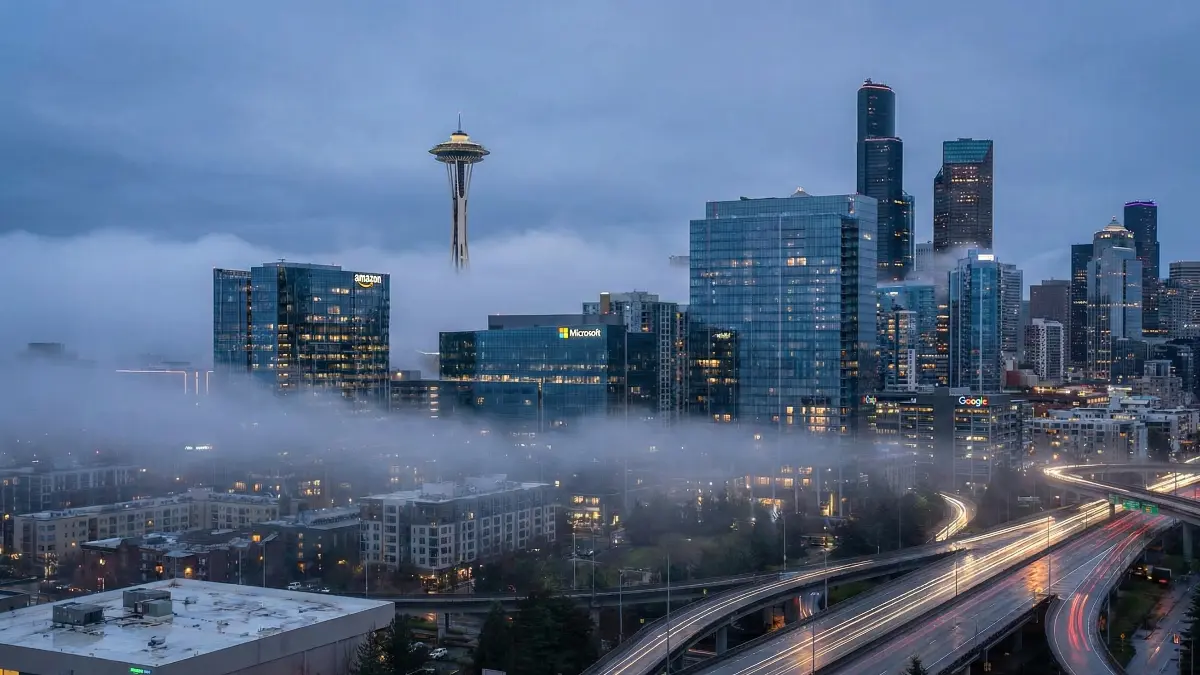
Hub 1: South Lake Union (SLU) & Denny Triangle
The “Amazonia” Core
Fifteen years ago, South Lake Union was mostly warehouses and cheap parking lots. Today, it is a shimmering canyon of glass and steel, almost entirely occupied by Amazon.
If you work at Amazon HQ (Day 1 Tower, the Spheres, etc.), Apple’s Seattle offices, or the massive new Meta buildings in the Denny Triangle, this is your epicenter.
The Vibe: Corporate & Convenient
SLU is incredibly clean, modern, and efficient. At lunchtime, the sidewalks are flooded with thousands of workers wearing blue badges. It has excellent fast-casual food (think $18 gourmet salads), high-end gyms, and immediate access to Lake Union for summer kayaking.
However, it can feel soulless. It is a neighborhood built for work. After 6:00 PM and on weekends, it empties out significantly. It lacks the gritty history of Capitol Hill or the cozy charm of Ballard.
Where to Live if You Work Here
Option A: South Lake Union (The High-Rises) Live right above the office.
- The Vibe: Luxury hotel living. Rooftop dog parks, concierges, package lockers, and AC (standard in new builds).
- The Commute: A 5-minute walk.
- 2026 Rent: Expect to pay $2,800 – $3,500 for a nice 1-bedroom.
Option B: Capitol Hill (Nightlife & Culture) Located just up the hill to the east.
- The Vibe: The cultural heart of the city. Historic brick buildings, vibrant LGBTQ+ scene, incredible restaurants, and loud nightlife.
- The Commute: A 15-minute walk downhill to work (or a quick ride on the Streetcar).
- 2026 Rent: $2,300 – $2,700 for older buildings; higher for new construction.
Option C: Lower Queen Anne (Uptown) Located to the west, near the Space Needle.
- The Vibe: A mix of tourists (near Seattle Center) and quiet residential streets. Lots of older apartment stock mixed with new condos.
- The Commute: A 20-minute walk or a quick bus ride on the D-Line.
- 2026 Rent: $2,200 – $2,600.
Hub 2: The Eastside (Redmond & Bellevue)
Microsoft Country & The Meta Expansion
Across Lake Washington lies “The Eastside.” This is suburban tech sprawl at its finest. It is cleaner, safer, has better-rated public schools, and is generally more conservative than Seattle proper.
The Vibe: Upscale Suburbia
Downtown Bellevue has transformed into “Little Manhattan,” with skyscrapers, luxury shopping (Bravern, Bellevue Square), and high-end dining. Redmond, home to the massive Microsoft campus, feels more like a sprawling office park surrounded by trees and suburbs. Meta (Facebook) also has a massive presence in the Spring District of Bellevue.
The 2026 Game Changer: The 2 Line
The biggest news for Eastside tech workers in 2026 is the full operation of the Sound Transit 2 Line (East Link Light Rail). It now connects Redmond Tech station directly to downtown Bellevue and across the lake to downtown Seattle.
This changes the commute dynamic, making living in Seattle and working on the Eastside slightly less painful—but driving across the bridges is still a nightmare.
Where to Live if You Work Here
Option A: Downtown Bellevue (Urban Luxury)
- The Vibe: Incredibly expensive, incredibly clean. High-rise condos that rival downtown Seattle prices. Great if you want city amenities without the “grit” of Seattle.
- The Commute: Minutes to Meta; 15 minutes to Microsoft.
- 2026 Rent: $3,000+ for a luxury 1-bedroom.
Option B: Redmond (The Microsoft Bubble)
- The Vibe: Quiet suburbia. Lots of apartment complexes geared towards tech families and H1B visa holders. Very diverse, great Indian and Asian grocery stores, and excellent parks (Marymoor Park).
- The Commute: You are practically living on campus.
- 2026 Rent: $2,400 – $2,800 for newer garden-style apartments.
Option C: Kirkland (Waterfront Charm)
- The Vibe: Located north of Bellevue on the lakefront. It feels like a resort town in the summer. It has a cute walkable downtown area with restaurants and beaches.
- The Commute: A short drive to Google’s Kirkland campus or Microsoft.
- 2026 Rent: $2,600 – $3,200 (higher near the water).
Hub 3: Fremont & The “Silicon Canal”
Google, Adobe, and Tableau
Just north of downtown Seattle, separated by the Lake Washington Ship Canal, sits a cluster of tech giants that prefer a quirkier vibe than SLU.
Google has a massive campus right on the water in Fremont. Adobe is nearby, and Tableau (Salesforce) is just across the water.
The Vibe: “Center of the Universe”
Fremont’s self-proclaimed motto is “De Libertas Quirkas” (Freedom to be Peculiar). It is famous for its naked bicyclists at the Solstice Parade and a giant statue of a troll under a bridge. It’s artsy, walkable, filled with breweries, and secretly very wealthy.
Where to Live if You Work Here
Option A: Fremont (Live Where You Work)
- The Vibe: Fun, active, and young. The Burke-Gilman trail runs right through it, making bike commuting easy.
- The Commute: Walk to Google.
- 2026 Rent: $2,400 – $2,800.
Option B: Ballard (The Brewery District) Located just to the west.
- The Vibe: A former Scandinavian fishing village turned hipster haven. It has the best Farmers Market in the city, dozens of breweries, and great restaurants along Ballard Ave.
- The Commute: A 15-minute bike ride or bus ride (the “Missing Link” of the bike trail is still a debate in 2026, but it’s rideable).
- 2026 Rent: $2,300 – $2,600.
Option C: Wallingford (Quiet Craftsman Homes) Located to the east.
- The Vibe: More residential and family-oriented. Beautiful old Craftsman homes, tree-lined streets, and access to Gas Works Park.
- The Commute: A quick walk or bike ride to the Google campus.
- 2026 Rent/Housing: Expensive to buy; renting a floor of a house often costs $2,500+.
The Final Verdict: Choosing Your Badge Color
When choosing where to live in Seattle in 2026, your employer badge dictates your geography.
- If you wear a Blue Badge (Amazon): Live in South Lake Union, Capitol Hill, or Queen Anne. Do not attempt to live on the Eastside unless you enjoy 2 hours of traffic a day.
- If you work at Microsoft/Meta (Eastside): Live in Bellevue, Redmond, or Kirkland. Embrace the suburban life. The schools are better, and the parking is free.
- If you are a Googler (Fremont): You have the best setup. Live in Fremont or Ballard and enjoy the best mix of city vibes and neighborhood charm.
Seattle is an incredible place to build a career in tech. Just make sure your apartment isn’t on the wrong side of the water.